GLENDALE, ARIZONA – AUGUST 08: Cardale Jones #7 of the Los Angeles Chargers looks to throw the ball against the Arizona Cardinals during the first half of an NFL preseason game at State Farm Stadium on August 08, 2019 in Glendale, Arizona. (Photo by Norm Hall/Getty Images)
Cut downs are happening all over the NFL, and GMs are scouring the waiver wire for talent. Who should the Green Bay Packers consider?
Six weeks of training camp and four preseason games have sorted out those that can make it from those that can’t. Teams have built their initial 2019 53-man rosters as cuts happened all over the NFL.
Even after the initial 53 players are announced, that doesn’t mean those same will be the players to suit up for Week 1.
There may be a player let go that a team coveted and was unable to sign. There also may still be holes teams couldn’t fill with their own drafted players or undrafted free agents. So waiver claims will be put in for players cut from other teams.
Waiver claims are made in the order of the draft. Teams with lower winning percentage get first choice of players cut. Claims are put in and then awarded after a 24-hour period. A corresponding move must be made to create room for the players claimed. We should have a better idea of what the Week 1 roster will look like by Sunday evening.
In addition to waivers, there are also veteran players looking for new teams.
There have been a few mild surprises like LeSean McCoy being let go in Buffalo and Brandon Marshall getting cut from the Raiders.
Those two players, as veterans, are not subject to waivers. They have over four years experience and are free to sign with whoever they want.
Let’s take a look at some additions who could help the Packers.
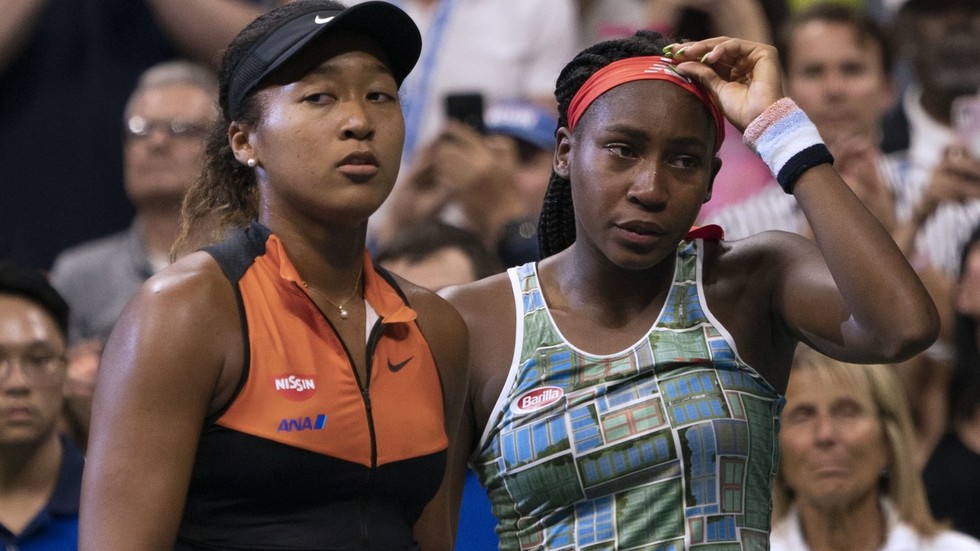
Defending champion Naomi Osaka has been hailed for her class after consoling beaten 15-year-old opponent Cori ‘Coco’ Gauff following the pair’s US Open third-round clash.
Top seed Osaka swept past Gauff in straight sets, 6-3, 6-0, in a dominant performance at Arthur Ashe Stadium.
But it was the 21-year-old Japanese star’s actions after the match which won her the most praise, as she consoled the defeated Gauff amid tearful scenes on court.
Osaka embraced Gauff and then urged her to join her in the post-match interview. An initially reluctance Gauff then agreed, leading to a mutual love-in from two of the game’s brightest young stars.
"I'm not the type of person who wants to cry in front of everyone. I didn't want to take that moment away from her," Gauff said when asked why she was initially unsure about joining Osaka for the interview.
"She told me it's better than crying in the shower. She convinced me multiple times to stay. I kept saying no. Finally I said, OK, I'll do it. Because I didn't know what to do.
"I'm happy that she kind of convinced me to do it because, I mean, I'm not used to crying in front of everyone."
A tearful Osaka, who rose to stardom with her victory at Flushing Meadows a year ago, paid tribute to Gauff’s team before incredibly apologizing for playing so well in her demolition of the teen.
"I am sorry for playing you in this mentality. It was super fun!" the Japanese star said.
The wholesome scenes drew praise from the tennis world, with women’s legend Martina Navratilova tweeting that the pair are “the future” of the sport.
Amazing stuff from both Coco Gauff and Naomi Osaka. This is the future , it is here and what great sports these two players are!!! #USOpen2019
Others hailed Osaka as a "class act" for the way she had comforted Gauff after her defeat, while NBA legend Kobe Bryant said that the future of tennis was "in great hands."
Osaka moves on to face Swiss 13th seed Belinda Bencic, as she aims to defend the title she won by beating Serena Williams in the final last year – a match that was marred by Williams’ furious outburst at umpire Carlos Ramos.
Despite her defeat, Gauff appears destined for big things. She famously burst onto the scene at Wimbledon earlier this year when she emerged from qualifying to beat Venus Williams, before losing in the fourth round to eventual champion Simona Halep.
Welcome! To bring you the best content on our sites and applications, Meredith partners with third party advertisers to serve digital ads, including personalized digital ads. Those advertisers use tracking technologies to collect information about your activity on our sites and applications and across the Internet and your other apps and devices.
You always have the choice to experience our sites without personalized advertising based on your web browsing activity by visiting the DAA’s Consumer Choice page, the NAI's website, and/or the EU online choices page, from each of your browsers or devices. To avoid personalized advertising based on your mobile app activity, you can install the DAA’s AppChoices app here. You can find much more information about your privacy choices in our privacy policy. Even if you choose not to have your activity tracked by third parties for advertising services, you will still see non-personalized ads on our site.
By clicking continue below and using our sites or applications, you agree that we and our third party advertisers can:
transfer your personal data to the United States or other countries, and
process your personal data to serve you with personalized ads, subject to your choices as described above and in our privacy policy.
ARLINGTON, Texas – There’s a potential No. 1 NFL draft pick at quarterback, unprecedented recruiting success filling the roster with five-stars and glistening facilities that would make Egyptian pharaohs blush.
These should be gilded times for the University of Oregon football program under Mario Cristobal, as the second-year Ducks coach is thriving in every aspect except game coaching. For the second consecutive year, Cristobal’s decisions late in games pulled defeat from the jaws of victory and appear to be holding the Ducks back from making the leap from good to great.
No. 11 Oregon blew its opener to No. 16 Auburn, 27-21, on Saturday night for a hundred different reasons, capped by a Bo Nix touchdown pass with nine seconds remaining. The Ducks dropped a touchdown pass, missed a chip-shot field goal and squandered another scoring opportunity with an unforgivable bungle of a simple quarterback-tailback exchange.
But the primary culprit in the aftermath of Oregon giving away a 21-6 second-half lead was Cristobal himself, as those nine seconds never should have been on the clock. Cristobal the game manager is undercutting the progress of Cristobal the program builder, and Saturday night should be the cruel lesson that prompts immediate change in how Oregon handles game management.
For the second consecutive season, a scintillating performance by the Ducks was thrown away in the final minutes. Last year it came at home against Stanford, as Cristobal declined to kneel the ball in victory formation and punt late in the game. Instead, he ran the ball into disaster, as CJ Verdell fumbled the ball and Oregon gave away the game in overtime.
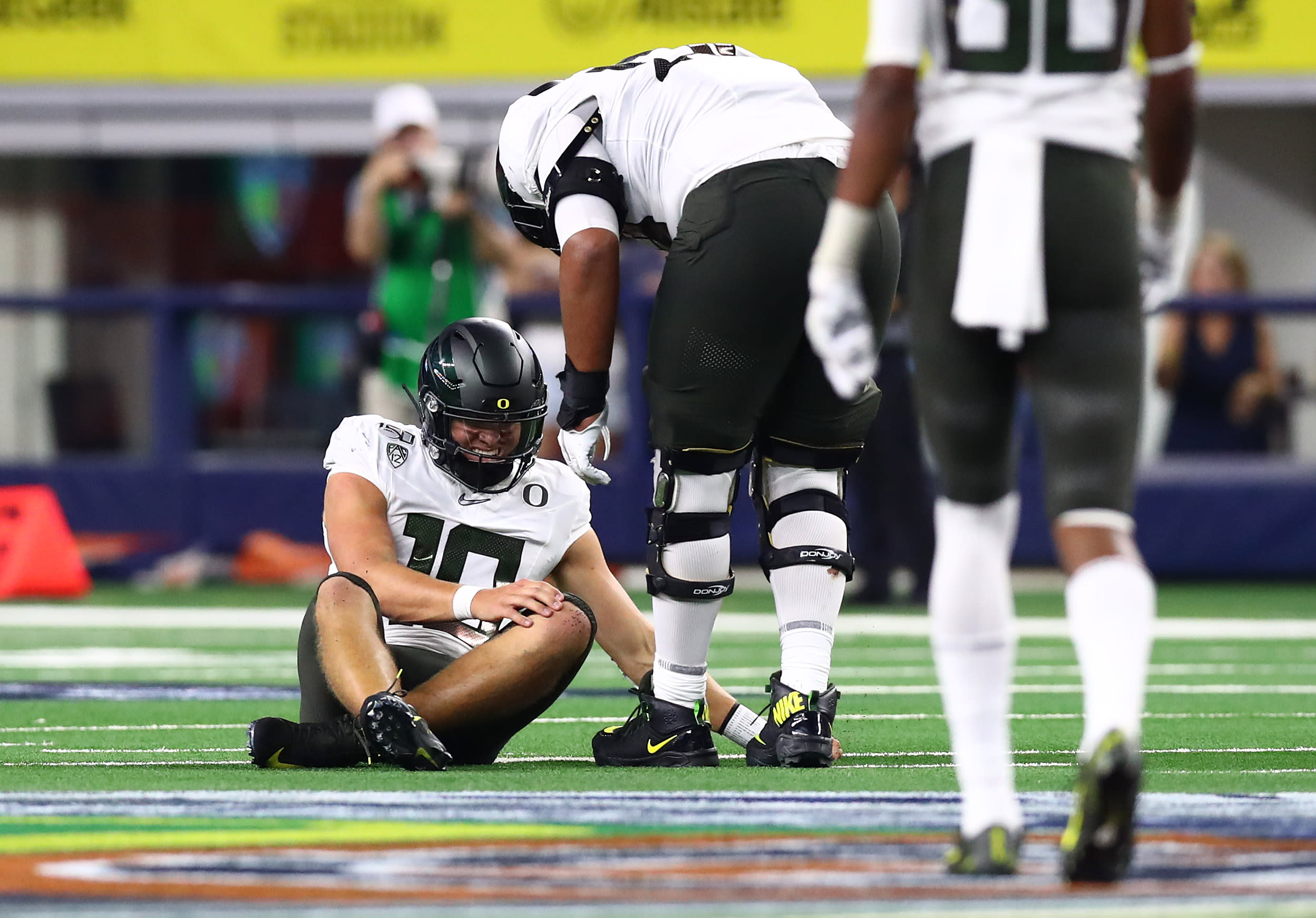
Oregon Ducks quarterback Justin Herbert (10) sits on the field hurt in the fourth quarter against the Auburn Tigers at AT&T Stadium. (USAT)
This time around, there’s a tasting menu of Cristobal fourth-quarter blunders. The ones that drew the most attention on Saturday night came when Oregon burnt back-to-back timeouts with 5:34 remaining amid a flurry lowlighted by the Ducks coaching staff not knowing basic timeout rules. That was inexcusable, as they attempted to call timeout to put Justin Herbert back in the game after he’d left with injury until the officials denied them. Somehow, none of the endless wave of Ducks assistants and analysts in those shiny $109 Nike polo shirts knew that rule — that a player couldn’t “buy back into the game” with a timeout, as the referee explained it. Oregon blew back-to-back timeouts amid the bedlam.
The moment embarrassed the Ducks coaching staff more than it cost them the game, underscoring the issues at hand without being fatal.
The cavalier clock management on the next possession can be more directly tied to Oregon’s demise. Oregon started that drive with 4:31 left on the clock and a 21-20 lead. They’d done a great job neutralizing Auburn’s salty defensive front all night, and the obvious plan here would have been to attempt to milk the clock, force Auburn to burn timeouts and win the game.
But Oregon, nursing that one-point lead, snapped the ball with 11 on the play clock on second-and-6. The next two downs, they did a little better in milking the clock down to five. Still, that’s at least 15 seconds – to be charitable – in a game that they lost with nine seconds remaining. That’s simple coaching negligence, easily first-guessed while it was happening and astounding when looking back to second-guess.
“We try and get the play in around 17, being that we snap the ball around five or six,” Cristobal said. “We also felt that we were going to have to score. We felt like we had to get in a rhythm, we didn’t feel that it would be a matter of taking the air out of the ball. We felt we were going to have to stay aggressive.”
That’s faulty logic at best, as minimizing Auburn’s opportunity to score should have been Cristobal’s priority. With the ball and a Duck defense that had Auburn quarterback Bo Nix look like he was running after a Dizzy Bat Race most of the night – he finished 13-for-31 passing with two interceptions – outgunning Auburn shouldn’t have been the priority. Limiting their opportunity made much more sense.
On the prior possession that began at 9:48, Oregon showed the same ambivalence toward milking the clock in the snaps before the timeout debacle. Oregon snapped the ball with 14 seconds left on the play clock, 14 seconds left on the play clock and then six seconds. Instead of playing to minimize possessions, Oregon unwittingly ended up keeping hope alive for Auburn. On the night, they basically gifted them a full game minute.
These are the types of situations where NFL front-office and coaching types laugh at the game management of college coaching staffs. Not coincidentally, most NFL teams have personnel dedicated to solely be thinking about these situations and advising coaches accordingly. The NFL types especially chuckle at tempo offenses – think Texas A&M in their historic fold at UCLA in 2017 – not being able to shed their identity in order to win games.
I asked Cristobal specially how Oregon’s game management process worked and if he had someone helping him.
“We have a chart that we go by in terms of the clock itself,” he said, “and how much time we can burn or how much time the other team can burn as it relates to timeouts, as it relates to whether there’s an injury, stoppage of play or the clock is continuing to run.”
It’s time for Cristobal to rip up the chart and acknowledge that he needs help, the same kind that the savviest of NFL coaches get. I also asked AD Rob Mullens who exactly is looking over the game management, and no one really had succinct answers.
It’s time for Phil Knight to dip into his coffers for another analyst. Heck, even Larry Scott would probably lend some of his $5.3 million-dollar salary to help out, as the Pac-12 desperately needed this win.
Simply put, the Stanford game last year and the Auburn game this year has left Cristobal branded as one of the worst game managers in all of the Power Five. This is simple and true. And he needs to realize that quickly, as his own inability to navigate late-game situations has already cost his program dearly.
Cristobal took umbrage to the Stanford game coming up last night, and he’s so sensitive about it that he went through his failed strategy again.
“Very different scenarios,” he said. “There were 13 seconds on the clock that we would have had to punt, chose not to punt, chose to go for it on second-and-2, just like two teams did that week as well. Very different scenarios.”
He’s right, the scenarios were different. But the results were strikingly similar. Oregon lost to No. 7 Stanford last year and No. 16 Auburn this year after poor clock management, games that knocked the Ducks out of the national conversation.
This has become a trend for Cristobal, one that’s up to him to reverse. It’s time for him to use another timeout and rethink however he’s managing games, as late-game strategy is undercutting the program’s searing momentum.
ARLINGTON, TEXAS - AUGUST 31: Head coach Mario Cristobal of the Oregon Ducks leads the Oregon Ducks against the Auburn Tigers in the second quarter during the Advocare Classic at AT&T Stadium on August 31, 2019 in Arlington, Texas. (Photo by Tom Pennington/Getty Images)